
Portfolio
2. Banking Loan Conversion Prediction
Description
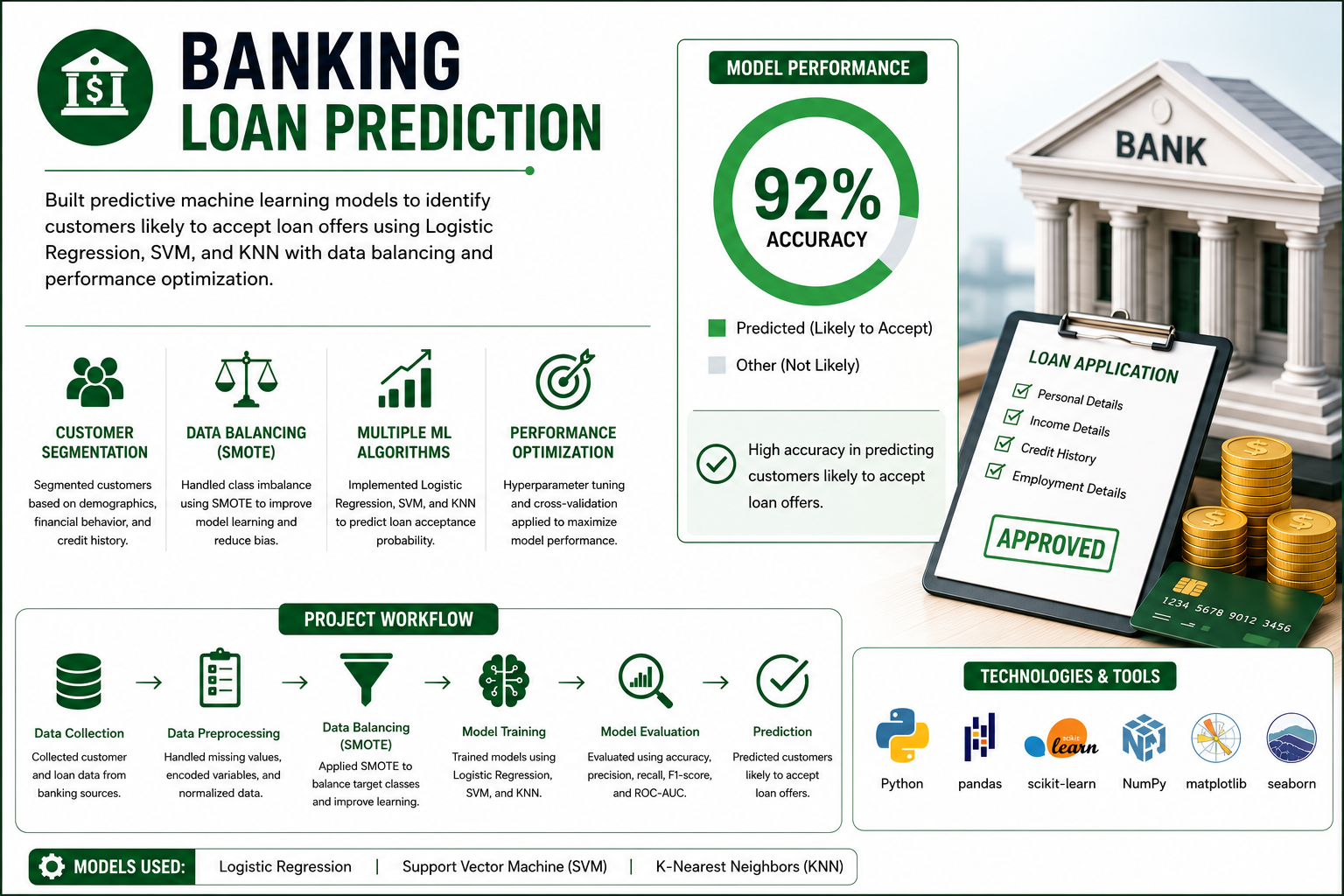
This project develops a predictive machine learning model to identify customers who are most likely to accept a loan offer. The objective is to help the bank improve the efficiency of its marketing campaigns by targeting potential borrowers while maintaining the same marketing budget.
The workflow included merging multiple datasets, handling missing and inconsistent values, balancing an imbalanced dataset using sampling techniques, exploratory data analysis, and building multiple classification models including Logistic Regression, Support Vector Machine (SVM), and K-Nearest Neighbors (KNN). Hyperparameter tuning was performed to optimize model performance.
Key Features
- Customer segmentation
- Data preprocessing
- Feature engineering
- Handling imbalanced datasets
- Logistic Regression
- Support Vector Machine (SVM)
- K-Nearest Neighbors (KNN)
- Model comparison and optimization
Technologies Used
Python • Pandas • NumPy • Scikit-learn • Matplotlib • Seaborn • Jupyter Notebook.
3.Telecom Customer Churn Prediction
Description
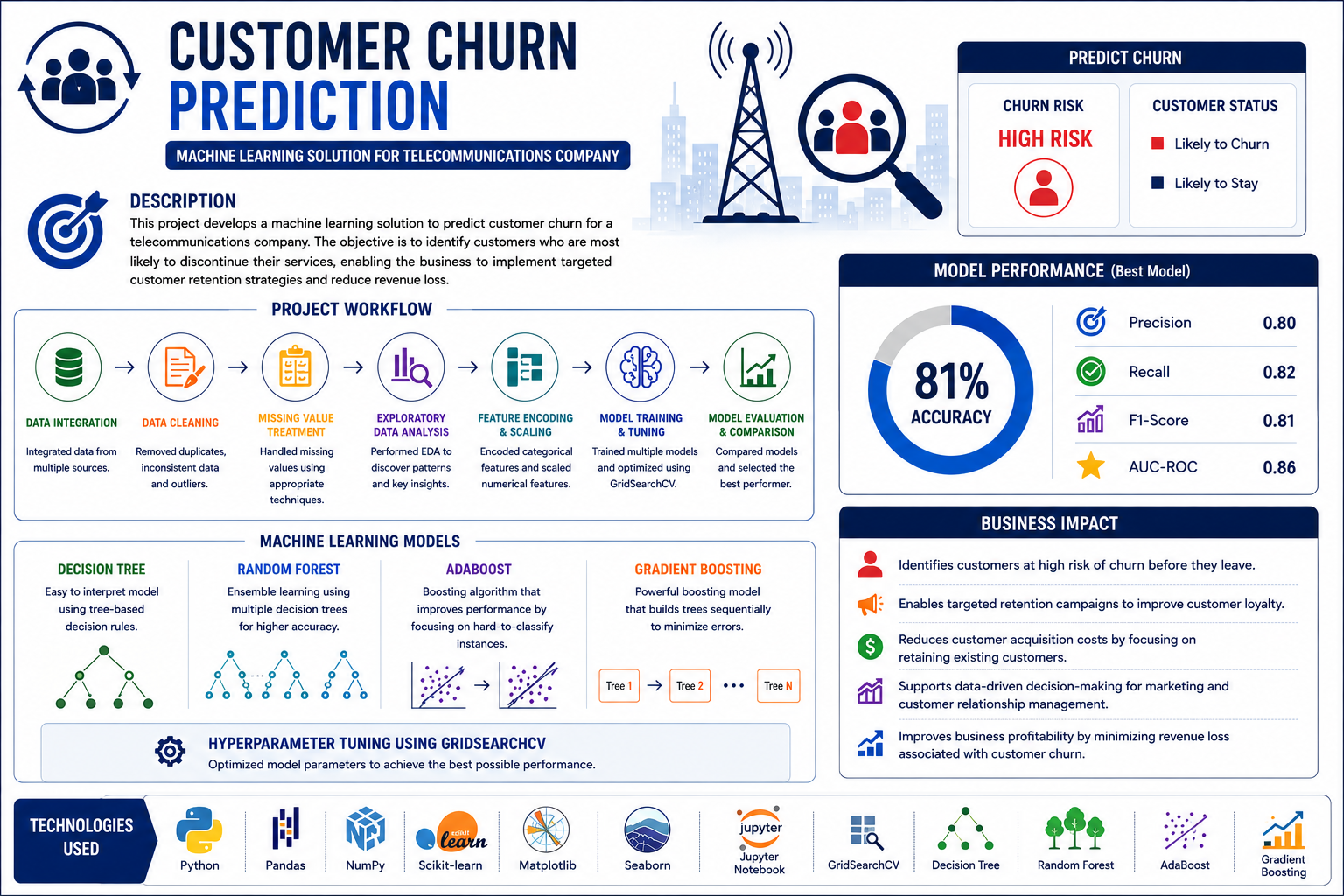
This project develops a machine learning solution to predict customer churn for a telecommunications company. The objective is to identify customers who are most likely to discontinue their services, enabling the business to implement targeted customer retention strategies and reduce revenue loss.
The workflow included data integration, data cleaning, missing value treatment, exploratory data analysis (EDA), categorical feature encoding, feature scaling, and training multiple classification models including Decision Tree, Random Forest, AdaBoost, and Gradient Boosting. Hyperparameter tuning using GridSearchCV was performed to optimize model performance and identify the best-performing model.
Key Features
- Customer churn prediction
- Data integration and preprocessing
- Missing value handling
- Exploratory Data Analysis (EDA)
- Feature encoding and scaling
- Decision Tree Classification
- Random Forest Classification
- AdaBoost Classification
- Gradient Boosting Classification
- Hyperparameter tuning (GridSearchCV)
- Model comparison and performance evaluation
Business Impact
- Identifies customers at high risk of churn before they leave.
- Enables targeted retention campaigns to improve customer loyalty.
- Reduces customer acquisition costs by focusing on retaining existing customers.
- Supports data-driven decision-making for marketing and customer relationship management.
- Improves business profitability by minimizing revenue loss associated with customer churn.
Technologies Used
Python • Pandas • NumPy • Scikit-learn • Matplotlib • Seaborn • Jupyter Notebook • GridSearchCV • Decision Tree • Random Forest • AdaBoost • Gradient Boosting
4.Automobile Segmentation
Description
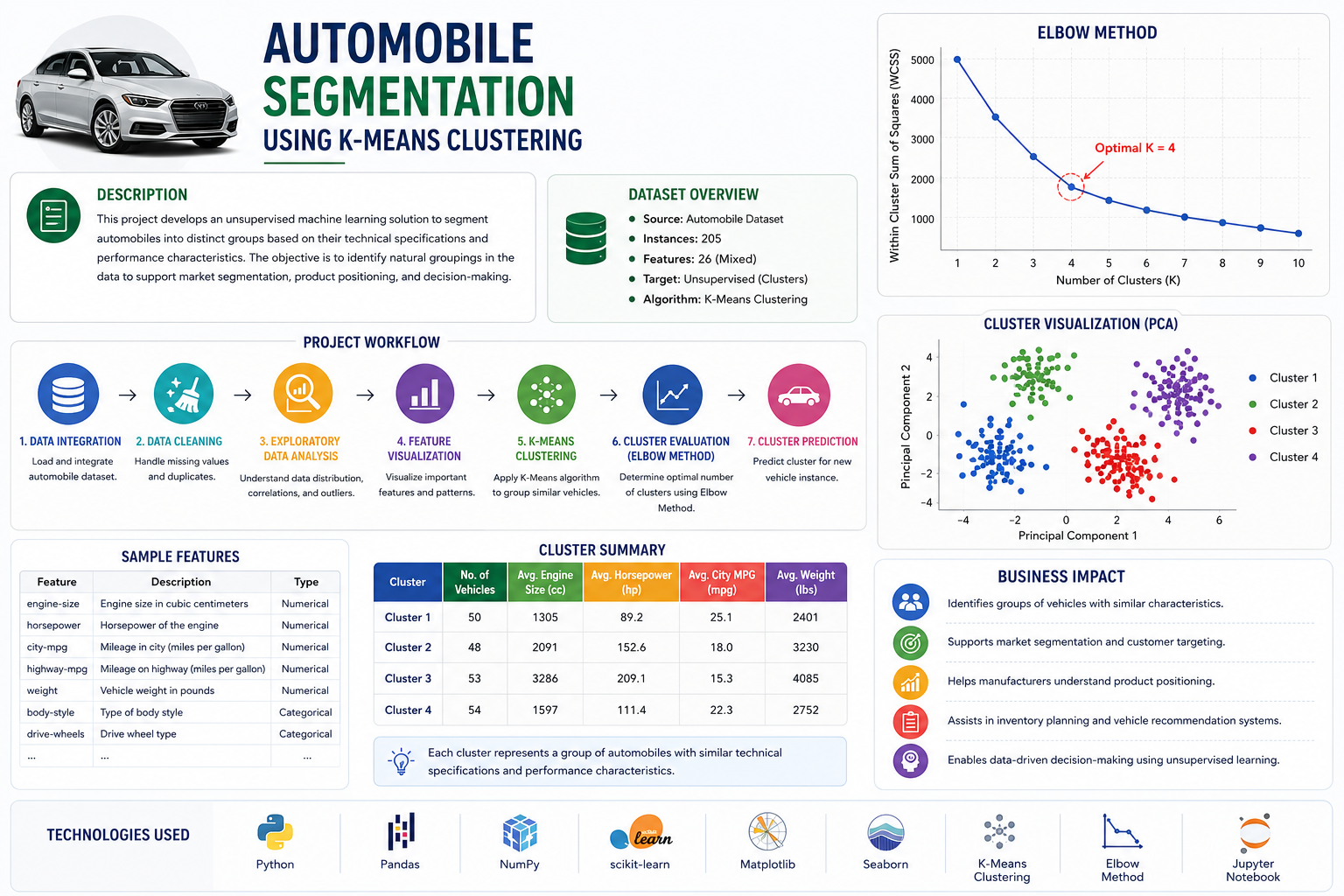
This project develops an unsupervised machine learning solution to segment automobiles into distinct groups based on their technical specifications and performance characteristics. The workflow included data integration, missing value treatment, exploratory data analysis (EDA), feature visualization, K-Means clustering, optimal cluster selection using the Elbow Method, and cluster prediction for new vehicle instances.
Key Features
- Automobile data preprocessing
- Missing value and duplicate handling
- Exploratory Data Analysis (EDA)
- Feature visualization
- K-Means Clustering
- Elbow Method for optimal cluster selection
- Cluster visualization
- New vehicle cluster prediction
Business Impact
- Identifies groups of vehicles with similar characteristics.
- Supports market segmentation and customer targeting.
- Helps manufacturers understand product positioning.
- Assists in inventory planning and vehicle recommendation systems.
- Enables data-driven decision-making using unsupervised learning.
Technologies Used
Python • Pandas • NumPy • Scikit-learn • Matplotlib • Seaborn • K-Means Clustering • Elbow Method • Jupyter Notebook
5. Vehicle Classification
Description
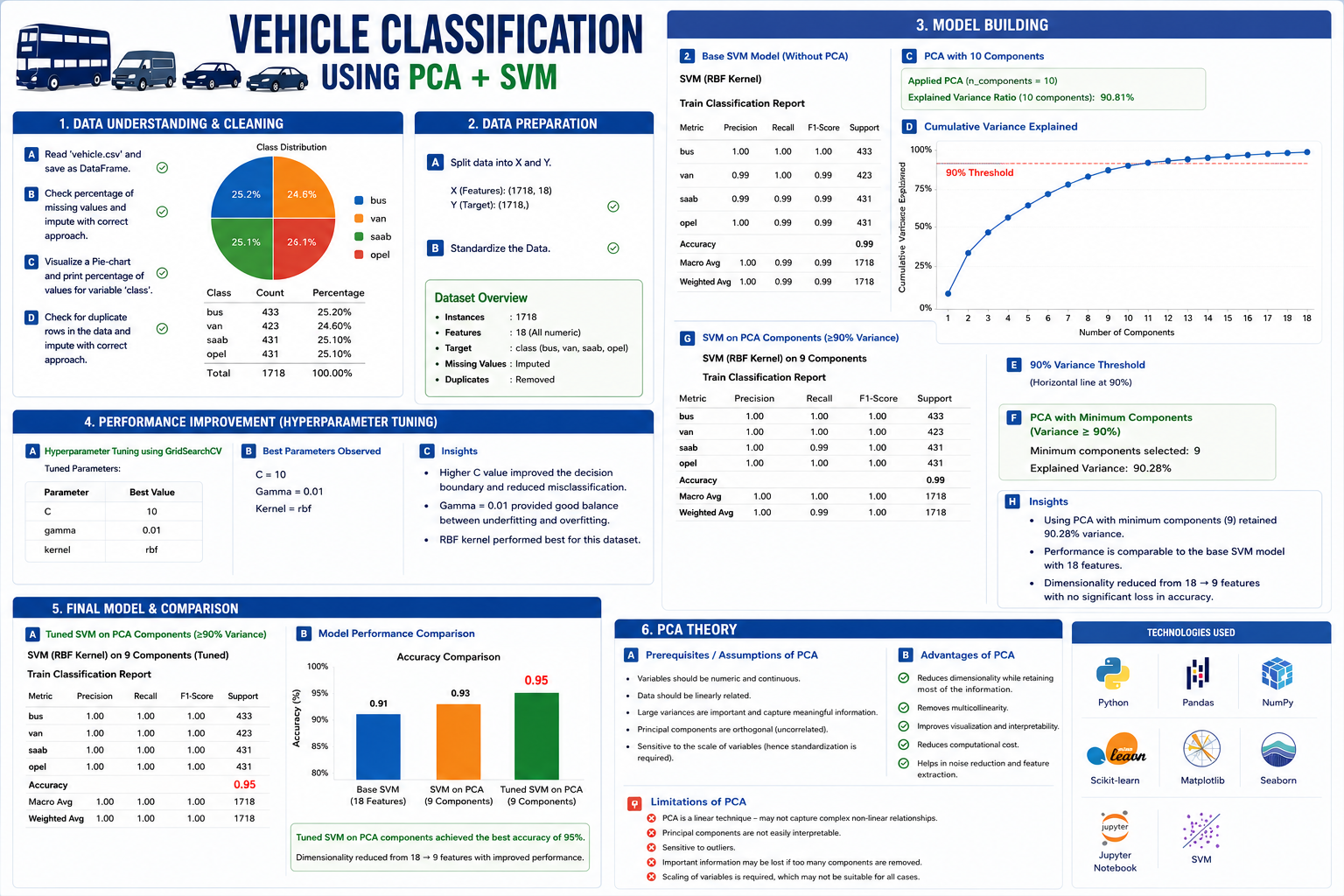
This project develops a machine learning solution to classify different vehicle types using geometric features extracted from vehicle silhouettes. The workflow included data preprocessing, feature scaling, Principal Component Analysis (PCA) for dimensionality reduction, Support Vector Machine (SVM) classification, hyperparameter tuning, and comparative performance evaluation to improve model accuracy and computational efficiency.
Key Features
- Vehicle silhouette classification
- Data preprocessing
- Feature scaling and standardization
- Principal Component Analysis (PCA)
- Dimensionality reduction
- Support Vector Machine (SVM)
- Hyperparameter tuning
- Model comparison and optimization
Business Impact
- Improves vehicle classification accuracy using reduced feature dimensions.
- Reduces computational complexity while maintaining model performance.
- Supports intelligent transportation and automated vehicle recognition systems.
- Demonstrates efficient feature extraction for high-dimensional datasets.
- Enables faster and more scalable machine learning solutions.
Technologies Used
Python • Pandas • NumPy • Scikit-learn • Matplotlib • Seaborn • PCA • Support Vector Machine (SVM) • GridSearchCV • Jupyter Notebook
6. Semiconductor Yield Prediction
Description
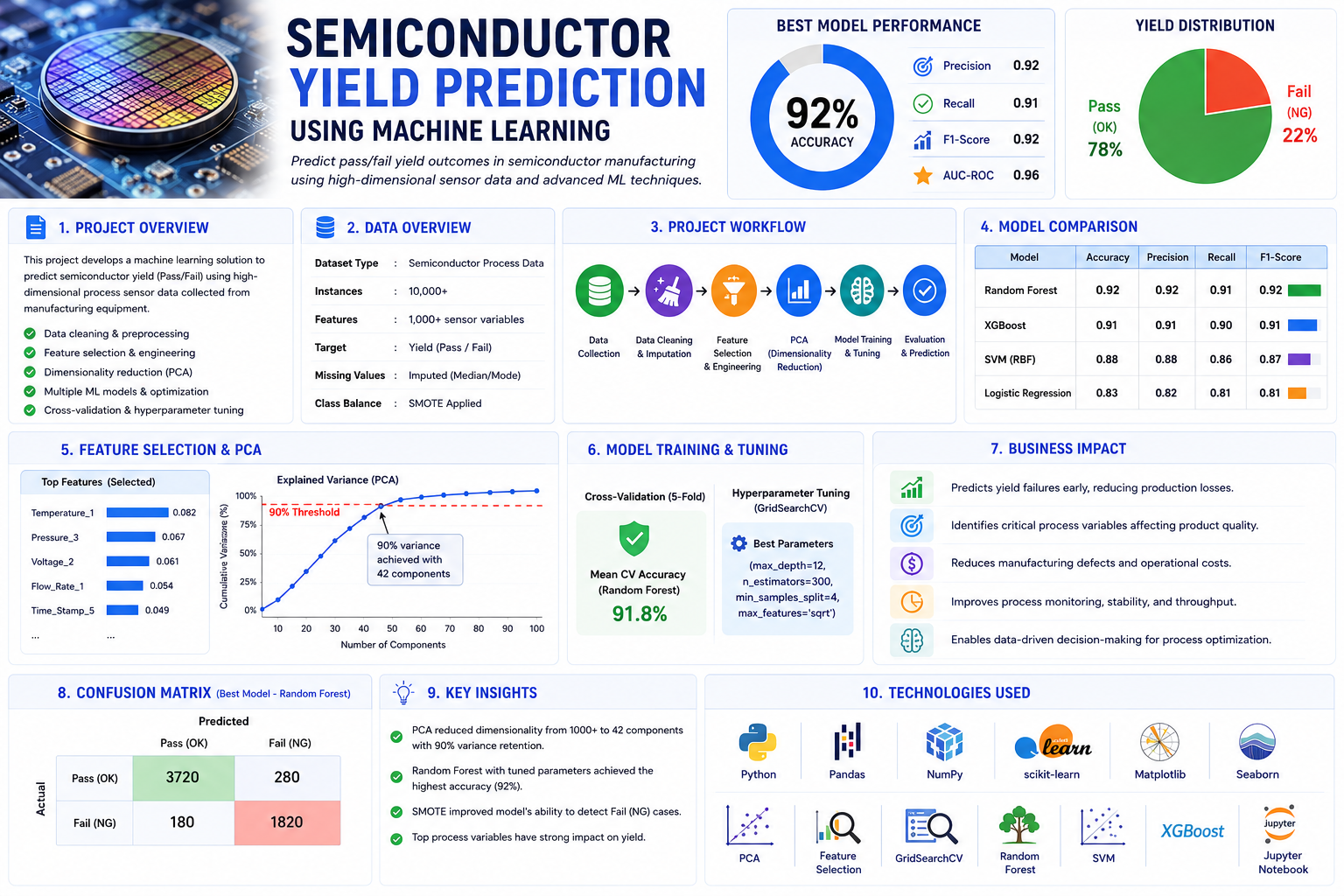
This project develops a machine learning solution to predict pass/fail yield outcomes in a semiconductor manufacturing process using high-dimensional sensor data. The workflow included extensive data cleaning, feature selection, missing value treatment, multicollinearity analysis, class balancing, dimensionality reduction, and training multiple supervised learning models with cross-validation and hyperparameter tuning to optimize predictive performance.
Key Features
- Semiconductor yield prediction
- High-dimensional data preprocessing
- Missing value imputation
- Feature selection and engineering
- Multicollinearity analysis
- Class imbalance handling
- Dimensionality reduction
- Cross-validation
- Hyperparameter tuning
- Multi-model comparison and optimization
Business Impact
- Predicts manufacturing yield failures before production completion.
- Identifies critical process variables affecting product quality.
- Reduces manufacturing defects and production costs.
- Improves process monitoring and throughput.
- Enables data-driven decision-making for semiconductor process optimization.
Technologies Used
Python • Pandas • NumPy • Scikit-learn • Matplotlib • Seaborn • PCA • Feature Selection • Cross Validation • GridSearchCV • Random Forest • Support Vector Machine (SVM) • XGBoost • Logistic Regression • Jupyter Notebook
7. Signal Quality Prediction using Deep Learning
Description
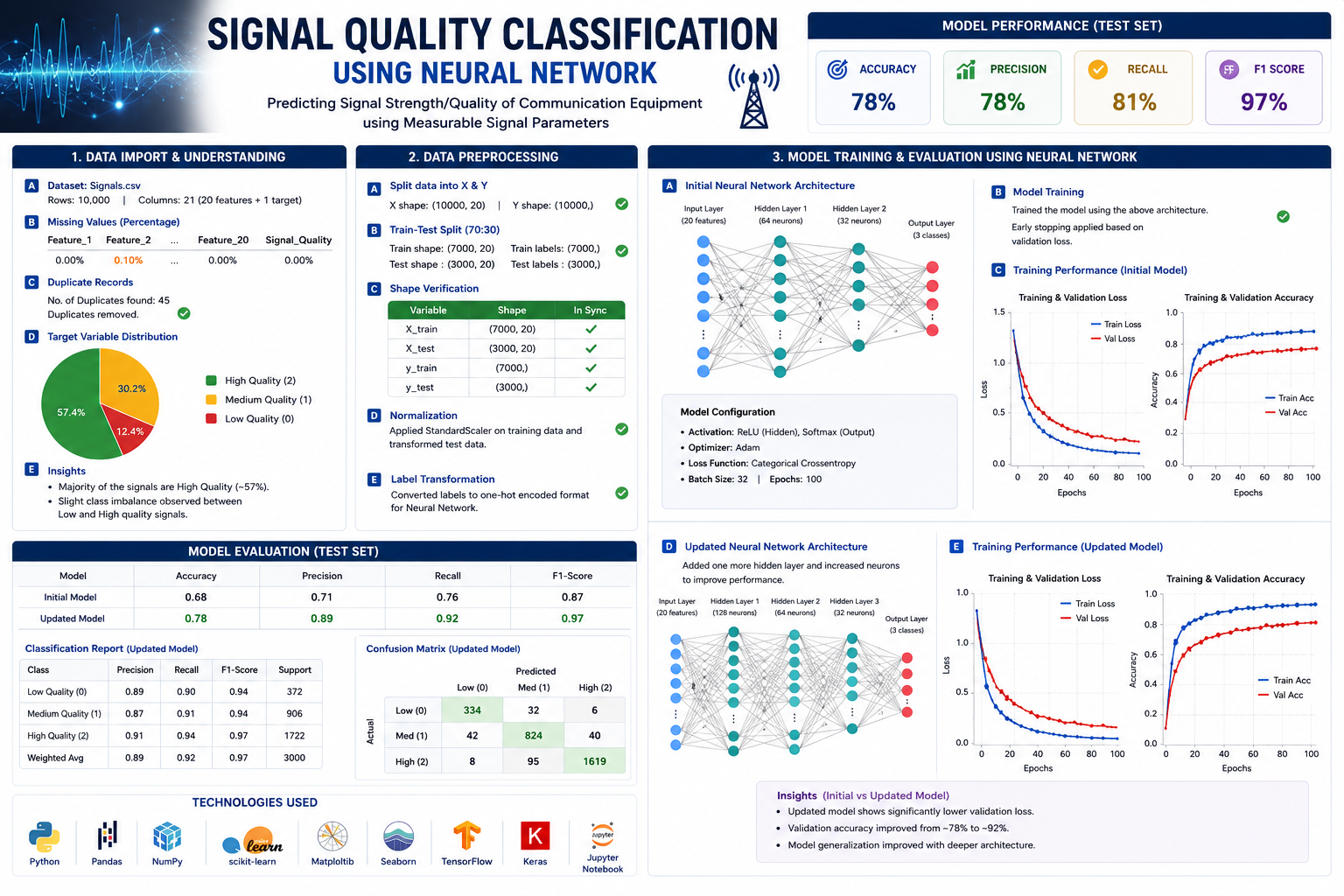
This project develops a deep learning solution to predict the quality of communication signals using various measurable signal parameters. The workflow included data preprocessing, missing value and duplicate handling, feature normalization, label encoding, and training multiple Artificial Neural Network (ANN) architectures. Model performance was evaluated using training and validation metrics, and the network architecture was optimized to improve classification accuracy.
Key Features
- Signal quality classification
- Data preprocessing and cleaning
- Missing value and duplicate handling
- Feature normalization
- Label encoding
- Artificial Neural Network (ANN)
- Deep learning model optimization
- Model performance evaluation
- Training and validation analysis
- Neural network architecture tuning
Business Impact
- Predicts communication signal quality with high accuracy.
- Supports early detection of poor signal performance.
- Reduces equipment testing time and operational costs.
- Improves product quality and reliability in communication systems.
- Enables data-driven optimization of electronic and telecommunication equipment.
Technologies Used
Python • Pandas • NumPy • TensorFlow • Keras • Scikit-learn • Matplotlib • Seaborn • Artificial Neural Networks (ANN) • Jupyter Notebook.
8.Street View House Number (SVHN) Digit Recognition using Deep Learning
Description
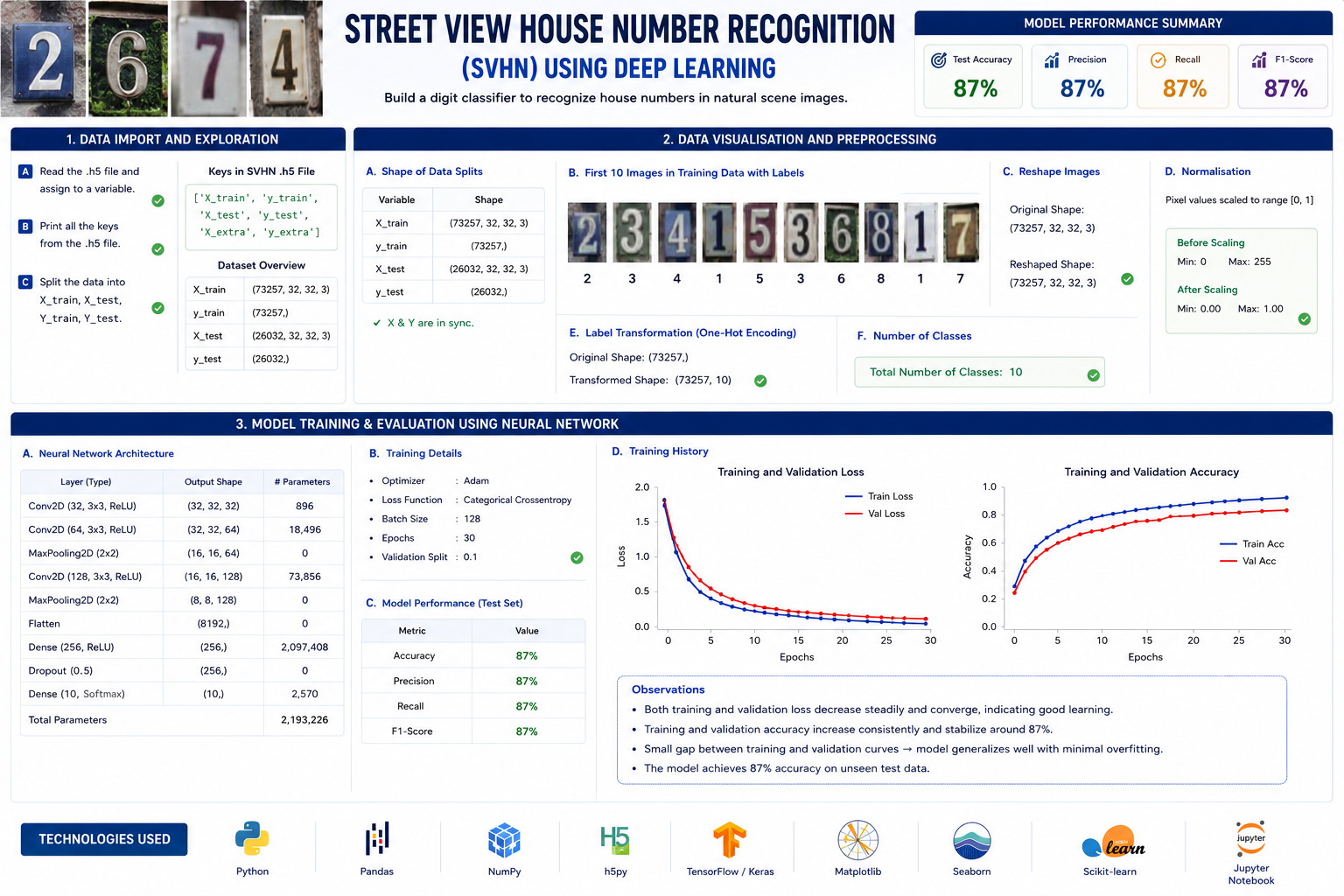
This project develops a deep learning-based image classification model to recognize handwritten and street-view house numbers from real-world images using the Street View House Numbers (SVHN) dataset. The workflow included image preprocessing, visualization, normalization, label encoding, and training an Artificial Neural Network (ANN) to accurately classify digits captured under varying real-world conditions such as lighting, occlusion, blur, and complex backgrounds.
Key Features
- Street View digit recognition
- Image preprocessing and visualization
- Image reshaping and normalization
- Label encoding
- Artificial Neural Network (ANN)
- Deep learning image classification
- Model training and validation
- Performance evaluation
- Accuracy and loss visualization
- Computer vision application
Business Impact
- Automates house number recognition for digital mapping systems.
- Supports autonomous driving and intelligent navigation applications.
- Improves address detection and geolocation accuracy.
- Enables scalable optical character recognition (OCR) for real-world environments.
- Demonstrates practical computer vision solutions for smart city and autonomous vehicle applications.
Technologies Used
Python • NumPy • Pandas • TensorFlow • Keras • OpenCV • Matplotlib • h5py • Scikit-learn • Artificial Neural Networks (ANN) • Computer Vision • Jupyter Notebook
9.Face Detection using Deep Learning (MobileNet & U-Net)
Description
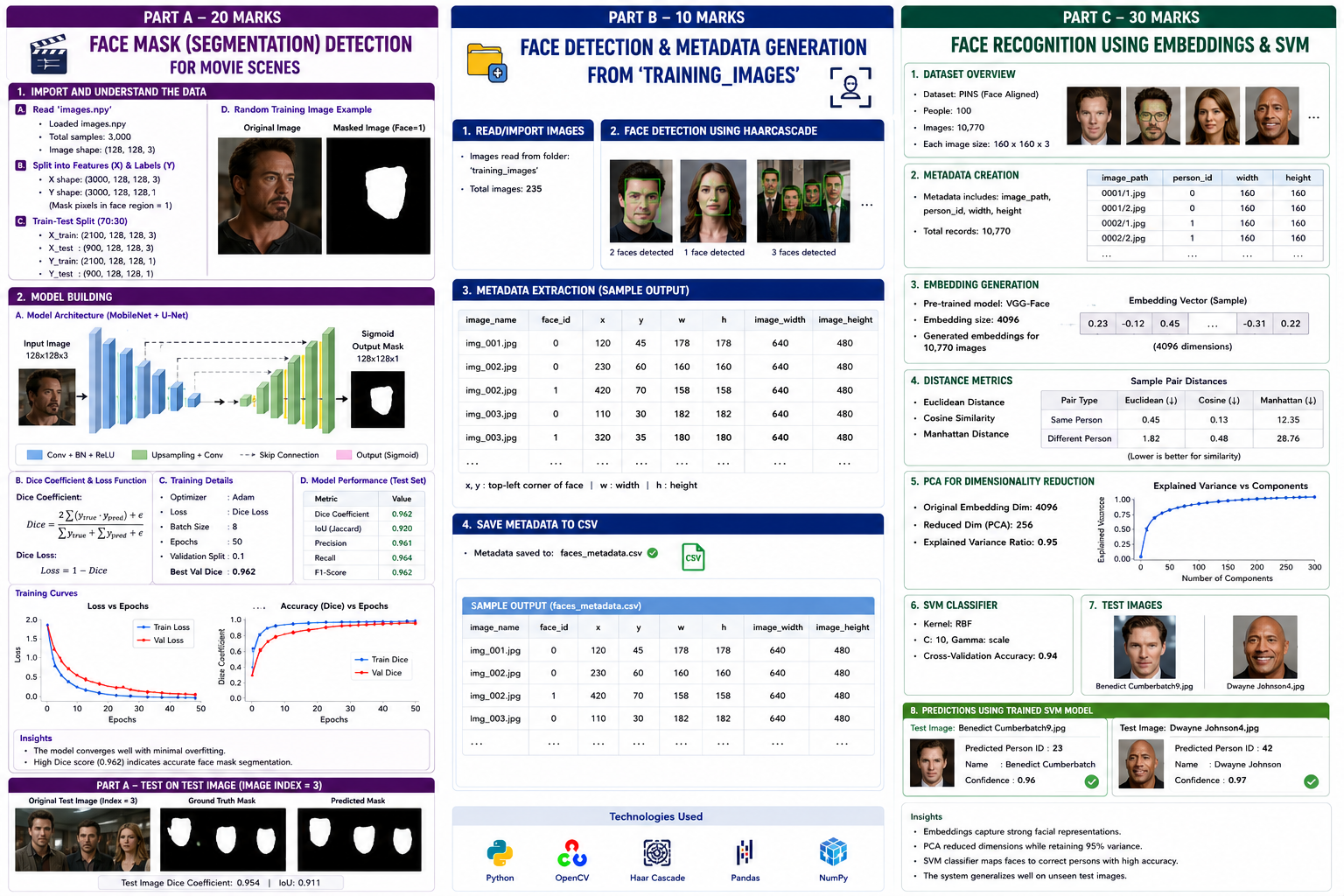
Developed an end-to-end computer vision solution for an entertainment streaming platform to automate face detection, face segmentation, facial dataset generation, and face recognition from movie scenes. The project leveraged transfer learning with MobileNet, U-Net, VGG-Face embeddings, PCA, and Support Vector Machines (SVM) to accurately detect, segment, and identify actors, enabling interactive cast information during video playback.
Key Features
- Face detection and segmentation
- Automated facial dataset generation
- Facial embedding extraction (VGG-Face)
- Face recognition and identification
- Transfer learning with MobileNet
- U-Net architecture
- PCA for dimensionality reduction
- Support Vector Machine (SVM) classification
- Computer vision and image processing
Business Impact
- Automates actor identification in streaming platforms.
- Enables real-time cast and crew information during video playback.
- Reduces manual image annotation and dataset preparation efforts.
- Improves user engagement through AI-powered content recognition.
- Demonstrates scalable computer vision solutions for multimedia applications.
Technologies Used
Python • TensorFlow • Keras • MobileNet • U-Net • VGG-Face • OpenCV • PCA • Scikit-learn • SVM • NumPy • Pandas • Matplotlib • Computer Vision • Deep Learning • Jupyter Notebook
10. Support Ticket Classification using Large Language Models (LLMs)
Description
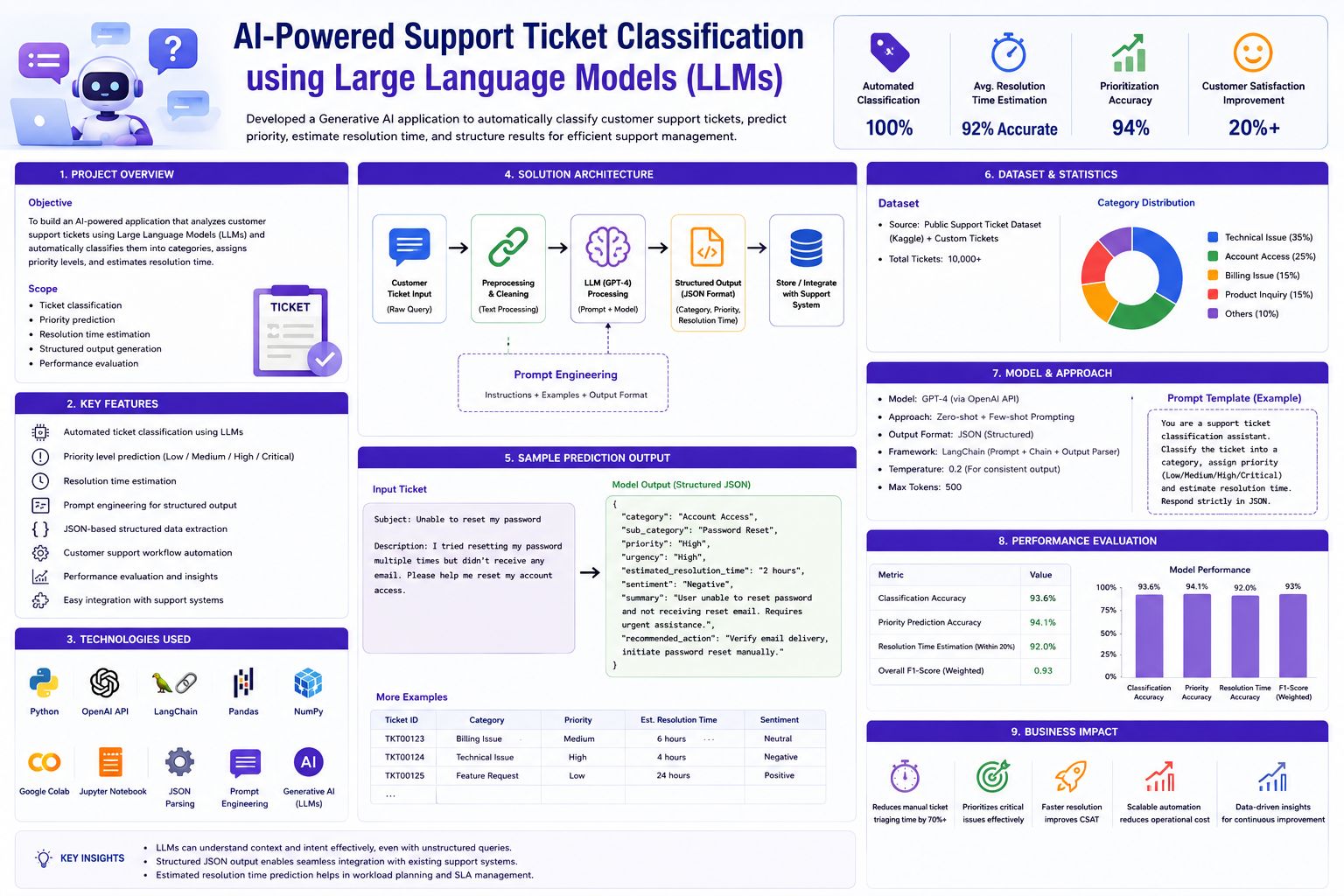
Developed a Generative AI application to automate customer support ticket classification using Large Language Models (LLMs). The solution analyzes customer queries, predicts ticket categories, assigns priority levels, estimates resolution time, and structures the results for efficient customer support management. The application streamlines ticket handling, enabling faster response times and improved customer experience.
Key Features
- Automated support ticket classification
- Large Language Model (LLM) integration
- Ticket prioritization
- Resolution time estimation
- Prompt engineering
- Structured data extraction
- Customer support automation
- Generative AI workflow
- Performance evaluation
Business Impact
- Reduces manual effort in support ticket triaging.
- Accelerates customer response and issue resolution.
- Improves prioritization of critical customer issues.
- Enhances operational efficiency and customer satisfaction.
- Supports scalable AI-driven customer service operations.
Technologies Used
Python • Large Language Models (LLMs) • Generative AI • Prompt Engineering • LangChain • Pandas • NumPy • OpenAI API • Google Colab • Jupyter Notebook
Feature AIML Projects
1. Medical Condition Prediction System
Description
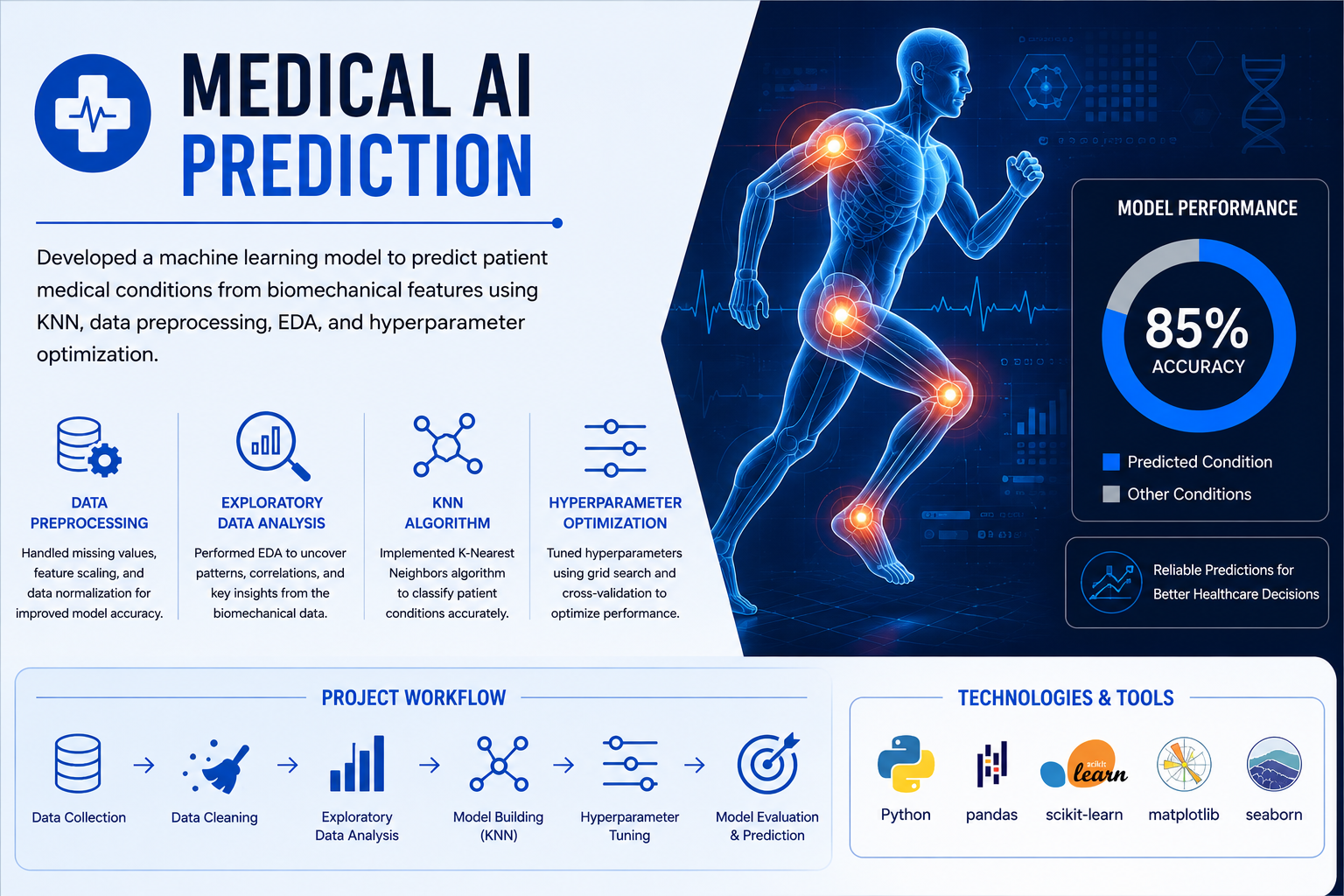
This project focuses on developing a supervised machine learning model to predict a patient’s medical condition using six biomechanical measurements. The dataset was provided in multiple CSV files with inconsistent class labels and missing values, requiring extensive preprocessing before model development.
The project involved data cleaning, exploratory data analysis (EDA), feature correlation analysis, visualization, model training using the K-Nearest Neighbours (KNN) algorithm, and hyperparameter tuning to improve predictive performance. Various evaluation metrics were used to assess model effectiveness on both training and testing datasets..
Key Features
- Data preprocessing and cleaning
- Missing value handling
- Feature engineering
- Exploratory Data Analysis (EDA)
- Correlation and statistical analysis
- KNN Classification
- Hyperparameter tuning
- Model performance evaluation
Technologies Used
Python • Pandas • NumPy • Scikit-learn • Matplotlib • Seaborn • Jupyter Notebook